Posts

Showing posts with the label Environmental Education

Easy Ways to Help Biodiversity

Image
Any help in any manner is better than no help at all. Awareness is the most imporant aspect towards environment protection and conservation. We are glad to share a few ways in which you can help Biodiversity. Plant Native Species Nothing can be more destructive to an ecosystem than the introduction of a new species. Invasive alien species are non-native plants or animals that are introduced accidentally or deliberately into an ecosystem where they are not normally found, with serious negative consequences for that ecosystem. So what can you do to ensure that local biodiversity is not impacted by invasive alien species? Very simply, you can help limit the spread of invasive alien species in your garden and instead plant local ones. Support Sustainable agricultural methods Agriculture had a tremendous impact on biodiversity. Intensive and monoculture farming depletes soil nutrients but it also strips the cultivated land from a range of organisms that help fight the spread of pests. S...

All about butterflies

Image
Butterflies the lovely and graceful insects provide economic and ecological benefits to the human society. Having multi hued colors on their wings, they enhance the earth’s beauty incontestably, and add immense aesthetic value to the ambient environment. They accomplish pollination, a key stone ecological process in natural sustainability throughout the world. Being development on vegetation on both as adults and larvae, they involve themselves in complex feeding relationships with green plants. As adults they require a succession of adequate nectar resources. Nectar provides energy for flight, which is vital to find makes and to disperse the species. As larvae, butterflies are typically host specific and often show a “Botanical instinct” in that closely related butterfly species choose closely related plants. As such butterflies provide the best rapid indicators of habit quality and also they are the sensitive indicators of climatic change. An estimated 20,000 - 25,000 species of b...

World Biodiversity Day - 22 May

Image
International Day for Biological Diversity - 22 May The United Nations has proclaimed May 22 The International Day for Biological Diversity (IDB) to increase understanding and awareness of biodiversity issues. Biodiversity basically describes the variety of living beings on earth. Otherwise termed as amount of variance of life. Biological diversity includes microorganism, plants, animals and ecosystems such as coral reefs, forests, rainforests, deserts etc. Biodiversity also talks about the abundance of different species living within a particular region. It represents the wealth of biological resources available to us. It’s all about the supporting the natural area made up of community of plants, animals, and other living things that has been decreasing at a steady rate as we plan human activities that affects the habitat thereby causes destruction. Every person matters and even you can do your bit to help in making this day a success. Support the birds, reptiles, mammals, and...

Green Tip of the Week - 6

Image
If you are trying to choose between two products, pick the one with the least packaging.

10 Easy Steps to Save Endangered Species

Image
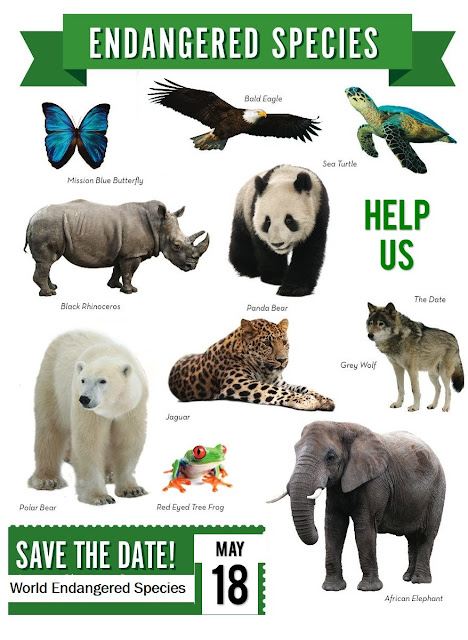
Everyone can contribute. where there is a will there is always a way. Follow these 10 simple steps to do your bit towards global efforts to save endangered species. Learn about endangered species in your area. Visit a national wildlife refuge, park or other open space Make your home wildlife friendly. Native plants provide food and shelter for native wildlife. Herbicides and pesticides may keep yards looking nice but they are in fact hazardous pollutants that affect wildlife at many levels.  Slow down when driving Recycle and buy sustainable products. Never purchase products made from threatened or endangered species. Harassing wildlife is cruel and illegal.  Protect wildlife habitat.

Endangered Species Day - May 18th

Image
Endangered Species Day is a chance for people of all ages to know and understand the importance of protecting endangered species and simple everyday activities they can take to help protect them. Started in 2006 by the United States Congress, Endangered Species Day is a celebration of the wildlife and wild places. Every year on the third Friday in May (and throughout the month), zoos, aquariums, parks, botanic gardens, wildlife refuges, museums, schools, community centers, conservation groups and other organizations hold tours, special speaker presentations, exhibits, children’s activities and more to celebrate Endangered Species Day. An endangered species is a species which has been categorized as very likely to become extinct. Endangered (EN), as categorized by the International Union for Conservation of Nature (IUCN) Red List, is the second most severe conservation status for wild populations in the IUCN's schema after Critically Endangered (CR). Read More…

Green Tip of the Week - 5

Image
Carpool if you find it difficult to walk or bike, use public transport instead. Every car off the road makes a difference.

World Migratory Bird Day

Image
World Migratory Bird Day is a two-day event annually held on the second weekend of May to highlight the need to protect migratory birds and their habitats. The United Nations is one of the many organizations that support this global awareness campaign. In 2018 it will be celebrated on 12th and 13th May.

Green Tip of the Week - 4

Image
Got a leaky toilet? you might just be wasting 200 gallons (757 Liters) of water a day.

Green Tip of the Week - 3

Image
Combine your errands - hit the post office, grocery store and shoe repair place in one trip. it will save your gas and time.

Green Tip of the Week - 2

Image
Leave your car at home. If you can stay off the road just two days a week, you will reduce greenhouse gas emissions by an average of 1590 pounds 9 721 kilograms) per year.

Earth Day

Image
Earth Day is an annual event celebrated on April 22. Worldwide, various events are held to demonstrate support for environmental protection. First celebrated in 1970, Earth Day events in more than 193 countries are now coordinated globally by the Earth Day Network. We here at Sricity Nature Society believe that Every single individual matters. Every single effort matters. So we are glad to share some simple ways to help you go green, protect the earth, save money and make every day Earth Day. You can make a difference! Join Earth Day Network’s campaign to End Plastic Pollution . Join a local group to cleanup parks rivers or beaches. Use environmentally-friendly, non-toxic cleaning products. Replace inefficient incandescent light bulbs with efficient CFLs or LEDs. Carpool, ride your bike, use public transportation or drive an electric or hybrid car. Reduce your carbon footprint by one pound for every mile you do not drive. Keep your tires properly inflated and get be...

Green Tip of the Week - 1

Image
Pay attention to how you use water. the little things can make a big difference. very time you turn off the water while your brushing your teeth, you are doing something good.

Green Tip of the Week

Image
Going green is easier than you think. There are little things you can do every day to help reduce greenhouse gases and make a less harmful impact on the environment. Taking care of the Earth is not just a responsibility — it’s a privilege.

World Water Day - 22nd March

Image
The World Water day, observed every year March 22, is a day about focusing attention on the importance of water and the need to preserve it. It is a day that reminds everyone about not wasting one of the most important elements that sustains life on the planet. Today, 2.1 billion people live without safe drinking water at home; affecting health, education and livelihoods around the world. The main reason being damaged ecosystems affect the quantity and quality of water available for human consumption. Take action Wherever you are and whatever you do on March 22, make it about nature and water.

Amazing Water Facts

Image
Less than 1% of the water supply on earth can be used as drinking water.  About 6,800 gallons (25,700 liters) of water is required to grow a day's food for a family of four. A person can live about a month without food, but only about a week without water. If a human does not absorb enough water dehydration is the result. Most of the earth's surface water is permanently frozen or salty. If all the world's water were fit into a gallon jug , the fresh water available for us to use would equal only about one tablespoon When water contains a lot of calcium and magnesium, it is called hard water. Hard water is not suited for all purposes water is normally used for. An acre of corn will give off 4,000 gallons (15,000 liters) of water per day in evaporation. A small drip from a faucet can waste as much as 34 gallons or 128 liters of water a day. Of all the water on earth, only 2.5% is fresh water. Fresh water is either groundwater (0,5%), or readily accessible wa...

International Day of Forests - 21st March

Image
A Forest is not just the trees, once lost, no amount of trees planting will bring it back. Trees are incredible. They can live for thousands of years and grow hundreds of metres tall. There is not a species on the planet that doesn’t owe its existence to them. This day we wish to raise awareness of the importance of all types of woodlands and trees. We can do our bit by making our cities greener and healthier place.

Forests our Protectors

Image
Forests and trees store carbon, which helps lessen the effects of climate change in and around urban areas.  Trees also clean the local climate, helping to save energy used for heating by 20-50 percent.  Strategic placement of trees in urban areas can cool the air by up to 8 degrees Celsius, reducing air conditioning needs by 30 percent.  Urban trees are excellent air filters, removing harmful pollutants in the air and fine particulates.  Trees reduce noise pollution, as they shield homes from nearby roads and industrial areas.  Local populations use the fruits, nuts, leaves and insects found in urban trees to produce food and medicines for use in the home, or as a source of income.  Wood fuel sourced from urban trees and planted forests on the outskirts of cities provides renewable energy for cooking and heating, which reduces pressures on natural forests and our reliance on fossil fuels.  Forests in and around urban areas help to filter an...

Connect with Sparrows

Image
Put bird boxes and bird feeders outside your house or in your gardens Water-bowls or a bird-bath in the hot summer afternoon helps birds to re-hydrate. Grow plants and hedges that are native to the place. This encourages some of the common birds to come back. Try to minimize pollution as much as possible. Minimize the use of your cell phone. If possible, use anti radiation cover to protect yourselves and to protect environment. Wisely use insecticides and pesticides. Over use of these substances are harmful in many ways. Don't do bigger things. Only by doing smaller things you can give your support to save this bird and to save our environment. 

Sparrow Fun Facts

Image
Sparrows have both genders males and females which can be easily distinguished by feather coloration. Females possess brown backs with stripes while males possess reddish backs and black bibs. Sparrows are said to be the social creatures. They live in colonies which are commonly mentioned to as flocks. Sparrows are primarily carnivorous by nature i.e. they are meat eaters. They learn to change their eating habit more frequently while they live in close association with Sparrows primarily eat moths and also feed on small insects. They can also feed on seeds, fruits, and berries. Sparrows easily adapt to the life in human settlements due to the constant supply of food. These creatures learn to eat food which they are provided by the people when people build their bird feeders. They usually fly at the speed of about 24 miles per hour, in the case of emergency they can speed up to 31 miles per hour. Although sparrows are not considered as water birds, they swim at a very fast pace...